

| Date: May 22, 2010 | Sponsor: DDRC | |
| River: 380 Greenbelt State Park (below Ray Roberts) | Trip Leader: Dale Harris | |
| Reach: Local | Phone: 972-814-2633 (cell) / 972-680-2727 (home) | |
| Difficulty: Flatwater * (See scale below) | E-mail: Dale Harris | |
| Rendezvous: Greenbelt State Park, 10:00 AM Saturday, May 22, 2010 | Required Skills: Basic flatwater paddling | |
| Campground: N/A | Confirmation Deadline: N/A |
| Trip Description:
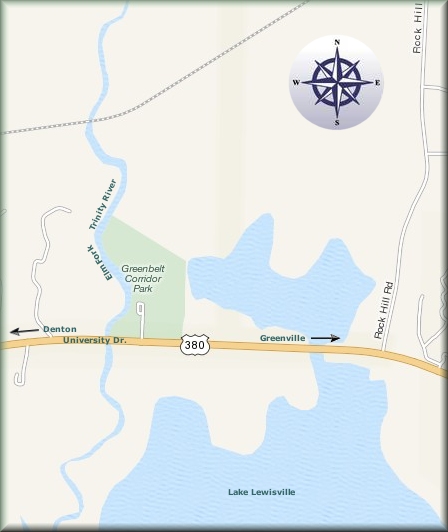
Meet at 10:00 AM Saturday, May 22nd, at 380 Greenbelt State Park on the Elm Fork of the Trinity River. We will paddle up stream about 1.5 miles, to Clear Creek, and come back to the park around noon for a "pot luck" picnic lunch. Bring sunscreen, sunglasses, folding chair, picnic or potluck lunch and plenty of water to drink. You must have life jackets with you on Trinity River.
Please watch the water gauge at Elm Fork at Trinity Greenbelt. If the gauge goes above 300 to 400 cfs it will be difficult to paddle up stream - the Trinity river is not really big above Lake Lewisville. Also, due to the wet weather the lakes are full and the Army Corps may raise the river levels for extended time periods to help drain the lakes to a safe level. Directions: Going west from McKinney or the Dallas North Tollway the park is about 1 mile west of the exit for Highway 377 North. Bring $5.00 to get into the park. Gear Requirements: Bring boats that are suitable for flatwater, PFD's (lifejackets), paddles (a spare is recommended), a whistle or other signalling device, throwbag, clothing for cool, wet conditions, camp chair, plate(s), flatware, drinking cup and some food item to share for the potluck lunch. A small cooler for drinks may be carried in your boat, if desired. Remember your ABC's about winter paddling - ANYTHING BUT COTTON! Wear synthetics because they keep you warmer and wick moisture away from your body reducing the chances of hypothermia. Above all else DO NOT paddle in cotton clothing in the winter! Meals: Bring something for the potluck lunch. Bring plenty of beverages, but remember - NO GLASS OR FOAM POLYSTYRENE STYROFOAM CONTAINERS! |
 |
| * International Scale of River Difficulty
Class I: Easy. Fast moving water with riffles and small waves. Few obstructions, all obvious and easily missed with little training. Risk to swimmers is slight, self-rescue is easy.
Class II: Novice. Straightforward rapids with wide, clear channels which are evident without scouting. Occasional maneuvering may be required, but rocks and medium sized waves are easily missed by trained paddlers. Swimmers are seldom injured and group assistance, while helpful, is seldom needed. Class III: Intermediate. Rapids with moderate, irregular waves which may be difficult to avoid and which can swamp an open canoe. Complex maneuvers in fast current and good boat control in tight passages or around ledges are often required; large waves or strainers may be present but are easily avoided. Strong eddies and powerful current effects can be found, particularly on large-volume rivers. Scouting is advisable for inexperienced parties. Injuries while swimming are rare; self-rescue is usually easy but group assistance may be required to avoid long swims. Class IV: Advanced. Intense, powerful but predictable rapids requiring precise boat handling in turbulent water. Depending on the character of the river, it may feature large, unavoidable waves and holes or constricted passages demanding fast maneuvers under pressure. A fast, reliable eddy turn may be needed to initiate maneuvers, scout rapids, or rest. Rapids may require "must" moves above dangerous hazards. Scouting is necessary the first time down. Risk of injury to swimmers is moderate to high, and water conditions may make self-rescue difficult. Group assistance for rescue is often essential but requires practiced skills. A strong eskimo roll is highly recommended. Class V: Expert. Extremely long, obstructed, or very violent rapids which expose a paddler to above average endangerment. Drops may contain large, unavoidable waves and holes or steep, congested chutes with complex, demanding routes. Rapids may continue for long distances between pools, demanding a high level of fitness. What eddies exist may be small, turbulent, or difficult to reach. At the high end of the scale, several of these factors may be combined. Scouting is mandatory but often difficult. Swims are dangerous, and rescue is difficult even for experts. A very reliable eskimo roll, proper equipment, extensive experience, and practiced rescue skills are essential for survival. Class VI: Extreme. One grade more difficult than Class V. These runs often exemplify the extremes of difficulty, unpredictability and danger. The consequences of errors are very severe and rescue may be impossible. For teams of experts only, at favorable water levels, after close personal inspection and taking all precautions. This class does not represent drops thought to be unrunnable, but may include rapids which are only occasionally run. |

 Copyright © 1996-2010, Dallas Downriver Club. All rights reserved. CobraGraphics is the trademark of Marc W. McCord dba CobraGraphics. The textual, graphic, audio, and audio/visual material in this site is protected by United States copyright law and international treaties. You may not copy, distribute, or use these materials except for your personal, non-commercial use. Any trademarks are the property of their respective owners. All original photographic images are the exclusive property of Dallas Downriver Club or other designated photographers and may not be copied, duplicated, reproduced, distributed or used in any manner without prior written permission of the copyright owner under penalty of US and International laws and treaties. |