
| Date: May 15-23, 2010 | Sponsor: DDRC | |
| Park: Buffalo National River, Arkansas | Trip Leader: Marc W. McCord | |
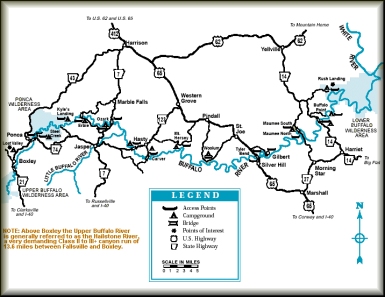
| Reach: Ponca to SH 14 (~ 95 miles) | Phone: 214-998-4922 | |
| Difficulty: Class I to II | E-mail: Marc McCord | |
| Rendezvous: Silver Hill Canoe Rental, Sunday, May 16, 2010, 9 AM | Outfitter: Silver Hill Canoe Rental (870-439-2372) | |
| Deposit: $50.00 - REQUIRED (Balance due before start of trip) | Confirmation Deadline: April 15, 2010 |
| Trip Description:
The Buffalo is America’s first National River, located in the heart of the southern Ozarks in northern Arkansas. This undammed, free-flowing clearwater river flows through a 135-mile corridor administered by the National Park Service and offers a real sense of wildness and isolation. You will float past towering multi-colored cliffs of limestone and sandstone that reach hundreds of feet above you. Dense forests line the banks, and hidden away in the flanking hollows are springs, caves, waterfalls, natural bridges and box canyons. There are prehistoric and historic cultural sites such as Archaic Indian bluff shelters or early settler cabins, some of which you can get to with a short hike.
Most of the river consists of easy flatwater, but in some sections we may encounter Class I-II rapids. The river is not considered to be technically difficult, but it is for paddlers who have had some river running experience. All rivers have inherent hazards such as rocks, shoals, and strainers. This is an unguided private, non-commercial trip, and each participant is responsible for his or her own personal safety, comfort, and equipment, as well as meals. We will probably run the reach from either Erbie or Ozark to US Highway 65, and possibly down to SH 14, depending upon water level at the time of the trip. If bringing a kayak please be prepared to haul ALL your own gear. Open canoes on the trip will be carrying their own gear, as well as some of the community gear, and will not have room for the gear of other paddlers. You should pack your boat at least twice before departing for the trip to make sure that everything you plan to take will fit. Once we arrive at the river put-in it will be too late to discover that your gear will not fit in your boat! Conway has everything you need in the way of lodging, restaurants, and stores in case you need any last minute supplies. Some of the group will arrive in Conway on Saturday, and stay there Saturday night, but motels are filling fast, so make reservations immediately if it is your intention to stay in Conway before heading up to Silver Hill, which is about 2 hours north of Conway. Otherwise, plan on meeting at Silver Hill Canoe Rental on Sunday, May 16, at 9 AM. Anybody wishing to rent a canoe or kayak at the river can do so from Silver Hill Canoe Rental. Those going up early will camp at Kyle's Landing and will not have to carry gear downriver on the first day of the trip. Anybody going directly to Silver Hill WILL have to carry gear on the first day! Visit Southwest Paddler for a full river description, photos and maps. Click "River Descriptions", then click "Arkansas", then select "Buffalo". Three reaches are described - we will probably be doing parts of the Middle and/or Lower Buffalo National River on this trip. Additional photos can be found in the Photo Gallery section of Southwest Paddler. This is a noncommercial, unguided, shared-expenses trip. A $50.00 non-refundable deposit is required, and the balance of shared expenses will be due before the trip starts, so bring adequate cash or send advance payment by check to Marc W. McCord at PO Box 835994, Richardson, TX 75083-5994. The exact amount will be determined before the April 15 confirmation deadline. Plan ahead and mark your calendar so you can paddle the Buffalo River, America’s first National River, located in the scenic Ozark Mountains of northwestern Arkansas. The Buffalo is suitable for canoeists and kayakers who have some experience on flowing water and have done some camping. For details call Marc McCord at 214-998-4922 or email him at canoeman@canoeman.com. Driving Directions: From Dallas: IH 30 East to IH 430 at Little Rock; IH-430 North to IH-40 West toward Conway; Exit onto US 65 North in Conway to Silver Hill, located where the highway crosses the Buffalo River; Watch for Silver Hill Canoe Rental on your left about one mile before the Buffalo River bridge. (Contact Marc, or consult the Buffalo National River website for directions to Kyle's Landing.) |
    |
| * International Scale of River Difficulty
Class I: Easy. Fast moving water with riffles and small waves. Few obstructions, all obvious and easily missed with little training. Risk to swimmers is slight, self-rescue is easy.
Class II: Novice. Straightforward rapids with wide, clear channels which are evident without scouting. Occasional maneuvering may be required, but rocks and medium sized waves are easily missed by trained paddlers. Swimmers are seldom injured and group assistance, while helpful, is seldom needed. Class III: Intermediate. Rapids with moderate, irregular waves which may be difficult to avoid and which can swamp an open canoe. Complex maneuvers in fast current and good boat control in tight passages or around ledges are often required; large waves or strainers may be present but are easily avoided. Strong eddies and powerful current effects can be found, particularly on large-volume rivers. Scouting is advisable for inexperienced parties. Injuries while swimming are rare; self-rescue is usually easy but group assistance may be required to avoid long swims. Class IV: Advanced. Intense, powerful but predictable rapids requiring precise boat handling in turbulent water. Depending on the character of the river, it may feature large, unavoidable waves and holes or constricted passages demanding fast maneuvers under pressure. A fast, reliable eddy turn may be needed to initiate maneuvers, scout rapids, or rest. Rapids may require "must" moves above dangerous hazards. Scouting is necessary the first time down. Risk of injury to swimmers is moderate to high, and water conditions may make self-rescue difficult. Group assistance for rescue is often essential but requires practiced skills. A strong eskimo roll is highly recommended. Class V: Expert. Extremely long, obstructed, or very violent rapids which expose a paddler to above average endangerment. Drops may contain large, unavoidable waves and holes or steep, congested chutes with complex, demanding routes. Rapids may continue for long distances between pools, demanding a high level of fitness. What eddies exist may be small, turbulent, or difficult to reach. At the high end of the scale, several of these factors may be combined. Scouting is mandatory but often difficult. Swims are dangerous, and rescue is difficult even for experts. A very reliable eskimo roll, proper equipment, extensive experience, and practiced rescue skills are essential for survival. Class VI: Extreme. One grade more difficult than Class V. These runs often exemplify the extremes of difficulty, unpredictability and danger. The consequences of errors are very severe and rescue may be impossible. For teams of experts only, at favorable water levels, after close personal inspection and taking all precautions. This class does not represent drops thought to be unrunnable, but may include rapids which are only occasionally run. |

 Copyright © 1996-2010, Dallas Downriver Club. All rights reserved. CobraGraphics is the trademark of Marc W. McCord dba CobraGraphics. The textual, graphic, audio, and audio/visual material in this site is protected by United States copyright law and international treaties. You may not copy, distribute, or use these materials except for your personal, non-commercial use. Any trademarks are the property of their respective owners. All original photographic images are the exclusive property of Dallas Downriver Club or other designated photographers and may not be copied, duplicated, reproduced, distributed or used in any manner without prior written permission of the copyright owner under penalty of US and International laws and treaties. |